 Add to Chrome
 Add to Firefox
 Add to Edge
Eigenvectors of Experts are Training-free Non-collapsing Routers
May 29, 2026
Sparse Mixture of Experts (SMoE) architectures improve the training efficiency of Large Language Models (LLMs) by routing input tokens to a selected subset of specialized experts. Despite their remarkable success, both training and inference in SMoE models suffer from the expert collapse issue (Chi et al., 2022), which degrades model performance. Prior studies primarily focus on improving the router; however, such methods rely on training from scratch or fine-tuning, which requires high computational and data-processing costs. Furthermore, we demonstrate that, despite these efforts, the issue persists when advancing well-pretrained SMoE models, as evidenced by both theoretical and empirical results. To fill that gap, we analyze the advanced SMoE models and observe that the eigenvectors of expert weight matrices encode rich semantic information, pointing to an effective alternative to conventional routing strategies. Building on this insight, we propose Singular Value Decomposition SMoE (SSMoE), a novel and training-free framework that leverages spectral properties of the expert weights to address the collapse issue and enhance model performance. Extensive experiments across diverse language and vision tasks, under both clean and corrupt data settings, demonstrate the strong generalization and robustness of SSMoE. Our findings highlight how a deeper understanding of model internals can guide the development of more effective SMoE architectures. Our implementation is publicly available at https://github.com/giangdip2410/SSMoE.
* 24 pages

Uncertainty-Aware Budget Allocation for Adaptive Test-Time Reasoning
May 26, 2026Sampling multiple responses improves language model reasoning, but uniform compute allocation is inefficient: easy questions are over-sampled while hard questions remain under-explored. We propose Uncertainty-Aware Budget Allocation (UAB), a concave integer optimization framework that reallocates a fixed sampling budget based on per-question uncertainty estimated at no additional inference cost. In Phase 1, every question receives one generation; its average negative log-likelihood (ANLL), extracted directly from output log-probabilities, serves as a difficulty signal while the generation contributes to the final vote. In Phase 2, the remaining budget is allocated by a marginal-greedy algorithm that solves a concave coverage-maximization surrogate exactly: uncertain questions receive more sampling budget while confident questions receive fewer additional samples. Evaluated on six open-weight and black-box models spanning 1.5B to 27B parameters and five reasoning benchmarks covering math, logic, and preference tasks, UAB outperforms baselines by up to +3% in average accuracy and up to +5% on individual benchmarks, with the largest gains in low-resource settings, requiring no auxiliary model or additional LLM call. Code is publicly available at https://github.com/manhitv/UAB.
Reviving Error Correction in Modern Deep Time-Series Forecasting
May 20, 2026Modern deep-learning models have achieved remarkable success in time-series forecasting. Yet, their performance degrades in long-term prediction due to error accumulation in autoregressive inference, where predictions are recursively used as inputs. While classical error correction mechanisms (ECMs) have long been used in statistical methods, their applicability to deep learning models remains limited or ineffective. In this work, we revisit the error accumulation problem in deep time-series forecasting and investigate the role and necessity of ECMs in this new context. We propose a simple, architecture-agnostic error correction model that can be integrated with any existing forecaster without requiring retraining. By explicitly decomposing predictions into trend and seasonal components and training the corrector to adjust each separately, we introduce the Universal Error Corrector with Seasonal-Trend Decomposition (UEC-STD), which significantly improves correction accuracy and robustness across 4 backbones and 10 datasets. Our findings provide a practical tool for enhancing forecasts while offering new insights into mitigating autoregressive errors in deep time-series models. Code is available at https://github.com/DA2I2-SLM/UEC-STD.
Continual Fine-Tuning of Large Language Models via Program Memory
May 13, 2026Parameter-Efficient Fine-Tuning (PEFT), particularly Low-Rank Adaptation (LoRA), has become a standard approach for adapting Large Language Models (LLMs) under limited compute. However, in continual settings where models are updated sequentially with small datasets, conventional LoRA updates struggle to balance rapid adaptation and knowledge retention. Existing methods typically treat the low-rank space as a homogeneous update region, lacking mechanisms to regulate how short-term updates are consolidated over time. We propose a continual LoRA framework with \textbf{Pro}gram memory, inspired by \textbf{C}omplementary \textbf{L}earning Systems in neuroscience. Our approach, dubbed \textbf{ProCL}, organizes LoRA adapters into structured program memory slots that are dynamically retrieved through input-conditioned attention. This enables rapid and localized adaptation, encouraging similar inputs to reuse shared adapter regions while reserving unused capacity for future data. The slots are then combined with the underlying adapter, which maintains a distributed representation that gradually accumulates knowledge across tasks to balance plasticity and stability. Our method operates entirely within the LoRA parameterization and incurs no additional inference cost. Experiments on diverse benchmarks demonstrate improved retention and reduced catastrophic forgetting over other continual LoRA strategies.
Beyond Majority Voting: Efficient Best-Of-N with Radial Consensus Score
Apr 14, 2026Large language models (LLMs) frequently generate multiple candidate responses for a given prompt, yet selecting the most reliable one remains challenging, especially when correctness diverges from surface-level majority agreement. Existing approaches, such as self-consistency, rely on discrete voting, while probability-based methods often fail to capture relationships among candidate answers or tend to underweight high-quality but less frequent responses, and do not fully leverage the geometric structure of answer representations. To address these limitations, we introduce Radial Consensus Score (RCS), a simple, efficient, and training-free method for best-of-N selection. RCS models semantic consensus by computing a weighted Fréchet mean (semantic center) of answer embeddings and ranking candidates by their radial distance to this center. Importantly, RCS provides a general framework that supports multiple weighting schemes, including uniform, frequency-based, and probability-based variants, enabling flexible integration of agreement signals and model confidence while remaining fully applicable in black-box settings. Extensive experiments across seven benchmarks covering short-form QA and long-form reasoning tasks, and five open-weight models, demonstrate that RCS variants consistently outperform strong baselines, with gains becoming more pronounced as the sampling budget increases. RCS also serves as an effective drop-in replacement for majority voting in multi-agent debate and exhibits strong robustness in black-box scenarios. Overall, these results highlight geometric consensus as a scalable and broadly applicable principle for reliable answer selection, extending beyond majority voting to more expressive and robust aggregation in LLM inference.
Do Domain-specific Experts exist in MoE-based LLMs?
Apr 07, 2026In the era of Large Language Models (LLMs), the Mixture of Experts (MoE) architecture has emerged as an effective approach for training extremely large models with improved computational efficiency. This success builds upon extensive prior research aimed at enhancing expert specialization in MoE-based LLMs. However, the nature of such specializations and how they can be systematically interpreted remain open research challenges. In this work, we investigate this gap by posing a fundamental question: \textit{Do domain-specific experts exist in MoE-based LLMs?} To answer the question, we evaluate ten advanced MoE-based LLMs ranging from 3.8B to 120B parameters and provide empirical evidence for the existence of domain-specific experts. Building on this finding, we propose \textbf{Domain Steering Mixture of Experts (DSMoE)}, a training-free framework that introduces zero additional inference cost and outperforms both well-trained MoE-based LLMs and strong baselines, including Supervised Fine-Tuning (SFT). Experiments on four advanced open-source MoE-based LLMs across both target and non-target domains demonstrate that our method achieves strong performance and robust generalization without increasing inference cost or requiring additional retraining. Our implementation is publicly available at https://github.com/giangdip2410/Domain-specific-Experts.
Hear Both Sides: Efficient Multi-Agent Debate via Diversity-Aware Message Retention
Mar 21, 2026Multi-Agent Debate has emerged as a promising framework for improving the reasoning quality of large language models through iterative inter-agent communication. However, broadcasting all agent messages at every round introduces noise and redundancy that can degrade debate quality and waste computational resources. Current approaches rely on uncertainty estimation to filter low-confidence responses before broadcasting, but this approach is unreliable due to miscalibrated confidence scores and sensitivity to threshold selection. To address this, we propose Diversity-Aware Retention (DAR), a lightweight debate framework that, at each debate round, selects the subset of agent responses that maximally disagree with each other and with the majority vote before broadcasting. Through an explicit index-based retention mechanism, DAR preserves the original messages without modification, ensuring that retained disagreements remain authentic. Experiments on diverse reasoning and question answering benchmarks demonstrate that our selective message propagation consistently improves debate performance, particularly as the number of agents scales, where noise accumulation is most severe. Our results highlight that what agents hear is as important as what agents say in multi-agent reasoning systems.
Spectral Text Fusion: A Frequency-Aware Approach to Multimodal Time-Series Forecasting
Feb 03, 2026Multimodal time series forecasting is crucial in real-world applications, where decisions depend on both numerical data and contextual signals. The core challenge is to effectively combine temporal numerical patterns with the context embedded in other modalities, such as text. While most existing methods align textual features with time-series patterns one step at a time, they neglect the multiscale temporal influences of contextual information such as time-series cycles and dynamic shifts. This mismatch between local alignment and global textual context can be addressed by spectral decomposition, which separates time series into frequency components capturing both short-term changes and long-term trends. In this paper, we propose SpecTF, a simple yet effective framework that integrates the effect of textual data on time series in the frequency domain. Our method extracts textual embeddings, projects them into the frequency domain, and fuses them with the time series' spectral components using a lightweight cross-attention mechanism. This adaptively reweights frequency bands based on textual relevance before mapping the results back to the temporal domain for predictions. Experimental results demonstrate that SpecTF significantly outperforms state-of-the-art models across diverse multi-modal time series datasets while utilizing considerably fewer parameters. Code is available at https://github.com/hiepnh137/SpecTF.
Federated Domain Generalization with Latent Space Inversion
Dec 11, 2025Federated domain generalization (FedDG) addresses distribution shifts among clients in a federated learning framework. FedDG methods aggregate the parameters of locally trained client models to form a global model that generalizes to unseen clients while preserving data privacy. While improving the generalization capability of the global model, many existing approaches in FedDG jeopardize privacy by sharing statistics of client data between themselves. Our solution addresses this problem by contributing new ways to perform local client training and model aggregation. To improve local client training, we enforce (domain) invariance across local models with the help of a novel technique, \textbf{latent space inversion}, which enables better client privacy. When clients are not \emph{i.i.d}, aggregating their local models may discard certain local adaptations. To overcome this, we propose an \textbf{important weight} aggregation strategy to prioritize parameters that significantly influence predictions of local models during aggregation. Our extensive experiments show that our approach achieves superior results over state-of-the-art methods with less communication overhead.
Empowering Multi-Turn Tool-Integrated Reasoning with Group Turn Policy Optimization
Nov 18, 2025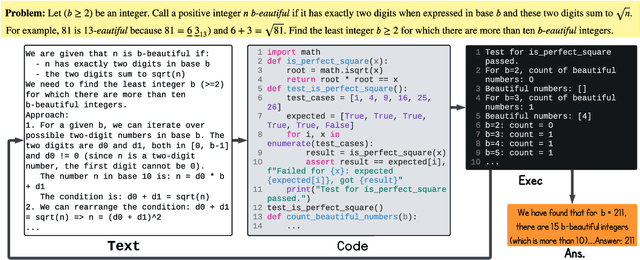
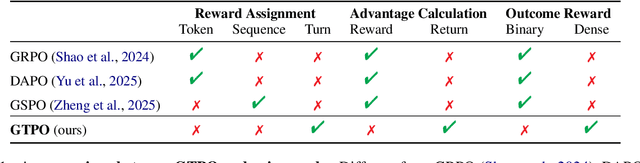
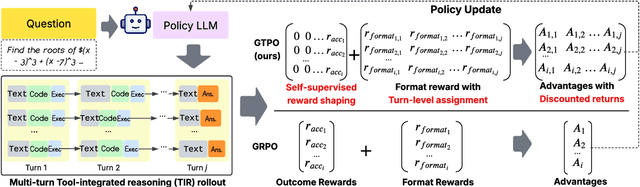
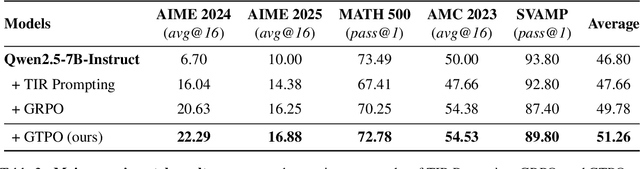
Training Large Language Models (LLMs) for multi-turn Tool-Integrated Reasoning (TIR) - where models iteratively reason, generate code, and verify through execution - remains challenging for existing reinforcement learning (RL) approaches. Current RL methods, exemplified by Group Relative Policy Optimization (GRPO), suffer from coarse-grained, trajectory-level rewards that provide insufficient learning signals for complex multi-turn interactions, leading to training stagnation. To address this issue, we propose Group Turn Policy Optimization (GTPO), a novel RL algorithm specifically designed for training LLMs on multi-turn TIR tasks. GTPO introduces three key innovations: (1) turn-level reward assignment that provides fine-grained feedback for individual turns, (2) return-based advantage estimation where normalized discounted returns are calculated as advantages, and (3) self-supervised reward shaping that exploits self-supervision signals from generated code to densify sparse binary outcome-based rewards. Our comprehensive evaluation demonstrates that GTPO outperforms GRPO by 3.0% on average across diverse reasoning benchmarks, establishing its effectiveness for advancing complex mathematical reasoning in the real world.